
Mosquitoes
 West Caldwell contains many wet\wetland areas that provide an ideal habitat for mosquitoes. From late Spring to early Fall, mosquitoes can be a significant nuisance particularly in residential areas adjacent to wetlands.
The Essex County Mosquito Commission is the lead agency for mosquito control in Essex County. The Commission employs a modern, integrated approach to mosquito control that includes monitoring, sampling, larval control, habitat reduction and adult mosquito control. The Essex County Mosquito Commission conducts inspections and control on both public and private property.
TO REPORT A MOSQUITO BREEDING SITE CALL: 973-239-3366 Ext. 2480
TRAVELING TO OR FROM THE CARIBBEAN?
The West Caldwell Health Department wants West Caldwell residents to know about the various mosquito-borne viruses that are common in the Caribbean Islands. Many of these viruses have infected people living in or visiting many Caribbean islands, including the Dominican Republic, Haiti, Puerto Rico and the US or British Virgin Islands.
For a full list of countries reporting mosquito-borne viruses, please visit the CDC Travelers' Health website.
Zika Virus
What we know
- Zika is spread mostly by the bite of an infected Aedes species mosquito (Ae. aegypti and Ae. albopictus). These mosquitoes are aggressive daytime biters. They can also bite at night.
- Zika can be passed from a pregnant woman to her fetus. Infection during pregnancy can cause certain birth defects.
- There is no vaccine or medicine for Zika.
- The Florida Department of Health has identified an area in one neighborhood of Miami where Zika is being spread by mosquitoes. Travel guidance for Essex County residents related to Miami neighborhood with active Zika spread
Zika Information
For the most up to date information on Zika please click on the links below:
Why Zika is risky for some people
Only Some People Need Zika Testing
Zika virus testing is recommended only for certain people. If you have questions or think you should be tested, talk to your healthcare provider.
If you have symptoms of Zika or are a pregnant woman, with or without symptoms, Zika testing is recommended if:
- You live in or traveled to an area with Zika.
- You had sex with a partner who lives in or traveled to an area with Zika.
Chikungunya Virus
What is Chikungunya Virus?
Chikungunya (pronunciation: \chik-en-gun-ye) virus is transmitted to people by mosquitoes. The most common symptoms of chikungunya virus infection are fever and joint pain. Other symptoms may include headache, muscle pain, joint swelling, or rash. Outbreaks have occurred in countries in Africa, Asia, Europe, and the Indian and Pacific Oceans. In late 2013, chikungunya virus was found for the first time in the Americas on islands in the Caribbean. There is a risk that the virus will be imported to new areas by infected travelers. There is no vaccine to prevent or medicine to treat chikungunya virus infection. Travelers can protect themselves by preventing mosquito bites. When traveling to countries with chikungunya virus, use insect repellent, wear long sleeves and pants, and stay in places with air conditioning or that use window and door screens.
It is transmitted by two types of mosquitoes, Aedes aegypti, and Aedes albopictus, both of which are present in Essex County. These mosquitoes bite mostly during the daytime.
Resources
CHIKUNGUNYA - Information for the general public
Dengue Hemorrhagic Fever (DHF)
What is the Dengue Hemorrhagic Fever (DHF)?
With more than one-third of the world’s population living in areas at risk for infection, dengue virus is a leading cause of illness and death in the tropics and subtropics. As many as 400 million people are infected yearly. Dengue is caused by any one of four related viruses transmitted by mosquitoes. There are not yet any vaccines to prevent infection with dengue virus and the most effective protective measures are those that avoid mosquito bites. When infected, early recognition and prompt supportive treatment can substantially lower the risk of medical complications and death. Dengue has emerged as a worldwide problem only since the 1950s. Although dengue rarely occurs in the continental United States, it is endemic in Puerto Rico and in many popular tourist destinations in Latin America, Southeast Asia and the Pacific islands.
Symptoms and What To Do If You Think You Have Dengue
Resources
West Nile Encephalitis
What is West Nile Encephalitis?
Encephalitis" means an inflammation of the brain and can be caused by viruses and bacteria, including viruses transmitted by mosquitoes. West Nile Encephalitis is an infection of the brain caused by West Nile virus, a flavivirus commonly found in Africa, West Asia, and the Middle East. West Nile virus was first detected in the Western Hemisphere in New York City in August, 1999.It is closely related to St. Louis encephalitis virus. West Nile virus is transmitted to people through the bite of a mosquito (primarily the Culex species) that is infected with West Nile virus. You can not contract West Nile Encephalitis from handling live or dead infected birds.
You can reduce your risk of being infected with WNV by using insect repellent and wearing protective clothing to prevent mosquito bites. There are no medications to treat or vaccines to prevent WNV infection. Fortunately, most people infected with WNV will have no symptoms. About 1 in 5 people who are infected will develop a fever with other symptoms. Less than 1% of infected people develop a serious, sometimes fatal, neurologic illness.
Resources
For the most up to date information on West Nile Encephalitis please click on the links below:
More Info on West Nile Encephalitis is Available Here
CDC Information on West Nile Encephalitis
U.S. Geological Survey West Nile Virus Info
New York City Dept. of Health West Nile Information Page
Homeowner Information
What can you do?
Mosquito control agencies can only do so much to prevent mosquitoes and the diseases that they transmit. As a resident of West Caldwell, you can help reduce mosquitoes around the home. In addition, taking certain precautions will help prevent your exposure to mosquito bites and the diseases that mosquitoes transmit.
Read the CDC information on avoiding mosquito bites
Rutgers website on dealing with the Asian tiger mosquito
Preventing Mosquito Bites
-
Use insect repellent - Some insect repellents are extremely effective at preventing mosquito bites and, when used correctly, do not pose a health concern. Repellents containing DEET, Picaridin or IR3535 have been shown to be the most effective. See the links below for additional information.
EPA-How to Use Insect Repellents Safely
CDC-Insect Repellent Use and Safety - Wear protective clothing - Cover exposed skin by wearing long sleeves, socks, and pants. Wear heavy clothing if possible, as mosquitoes can bite through some thin clothing. Also, treating clothing with a repellent such as permethrin will provide additional protection.
- Avoid mosquitoes - Although a few species of mosquitoes will bite during the daytime, most mosquitoes are active between dusk and dawn. Peak hours are from just before dark until 2-3 hours after dark. Try to avoid the outdoors during those times. During the daytime, mosquitoes rest in humid shaded areas. Avoid these areas such as woodlands, marshes, wetlands, etc., whenever possible. Mosquitoes will feed even during the daytime if you get close enough to where they are resting.
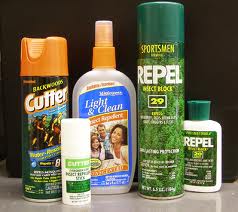
What about DEET?
Used as directed insect repellent products containing DEET (N,N-Diethyl-3-Methylbenzamide) can provide effective protection against mosquitoes. DEET was developed by the U.S. Dept. of Agriculture and patented in 1946 by the U.S. Army. It was approved for use by the general public in 1957. The Environmental Protection Agency estimates that more than 38 percent of the U.S. population uses DEET-based repellents each year.
CDC recommendations for Insect Repellents:
- Apply insect repellent sparingly to exposed skin. An effective repellent will contain 20% to 35% DEET (N,N-diethyl-meta-toluamide). DEET in high concentrations (greater than 35%) may cause side effects, particularly in children; avoid products containing more than 35% DEET.
- Repellents may irritate the eyes and mouth, so avoid applying repellent to the hands of children. Insect repellents should not be applied to very young children (< 3 years old).
- Spray clothing with repellents containing permethrin or DEET, as mosquitoes may bite through thin clothing.
- Whenever you use an insecticide or insect repellent, be sure to read and follow the manufacturer's DIRECTIONS FOR USE, as printed on the product.
More info on DEET from: EPA and the Mayo Clinic.